
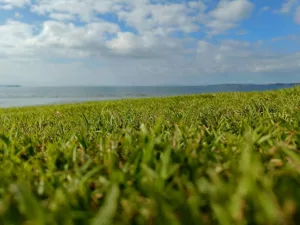
Living near the coast has plenty of perks, but a healthy, green lawn usually isn’t one of them without some extra help.
In coastal areas, high salt concentration in the air, sandy soil, a humid climate, and stormy weather create conditions for lawn development that cannot be compared with that of an average lawn. In fact, grass that grows well under usual conditions cannot survive there because it becomes thin and yellow, or suffers from various diseases and pests that thrive in such a climate.
Once you understand why this happens, it’s much easier to fix. It’s also why a one-size-fits-all approach to lawn care rarely works this close to the water. Coastal lawns need a plan tailored to their specific environment, not a generic program designed for a totally different climate.
Here’s a closer look at how coastal conditions affect your lawn, and what it really takes to keep it healthy anyway.
1. Salt Air and Sandy Soil Change What Your Lawn Needs
Coastal breezes carry fine salt particles that settle on grass blades and soil, which can dehydrate turf, damage leaf tissue, and reduce grass’s ability to absorb water efficiently.
Combined with sandy soil, which is characteristic of the region and allows fast drainage but poor nutrient retention, your lawn requires different care than in other parts of North Carolina.
Sandy soil drains quickly, but this comes with reduced water retention and nutrient availability, resulting in a loss of fertilizer before plants have had a chance to reap its benefits. This is why Freedom Lawns of Jacksonville designs its programs specifically for coastal soil conditions rather than applying a generalized fertilizer program based on the region.
2. High Humidity Creates the Perfect Conditions for Lawn Disease
The same warm, moist air that makes coastal living pleasant is also ideal for fungal lawn diseases like brown patch and dollar spot. High humidity keeps grass blades damp for longer stretches, especially overnight, giving fungal spores the moisture window they need to take hold and spread.
Left unmanaged, these diseases can spread quickly through a lawn during the peak of summer, leaving behind circular brown patches or thinning areas that are far harder to fix after the fact than to prevent in the first place. Coastal lawns benefit from disease monitoring and preventive treatment tailored to this humidity pattern, rather than reactive treatment only after symptoms appear.
3. Sandy Soil Struggles to Retain Water and Nutrients
Given that sandy soils near the coast drain extremely rapidly, turfgrass grown in this area is likely to require additional watering and fertilizing compared to turf grown on soils with better water retention properties. One big application of fertilizer or water will pass directly through the root zone without being available to the grass; an irrigation plan that is efficient for inland turf may be ineffective in coastal areas.
Thus, slow-release fertilizers and regular irrigation with shorter time intervals would work much better in sandy soil conditions.
4. Intense Sun and Heat Add Extra Stress to Coastal Turf
Coastal properties often experience more direct and reflected sunlight than shaded inland yards, particularly in open areas near water with little natural windbreak or tree cover. Combined with the region’s long, hot, and humid summers, this extra sun and heat exposure puts additional stress on grass, especially varieties that aren’t naturally suited to withstand it.
Lawns already weakened by salt exposure or nutrient-poor soil have even less resilience to fall back on during a heat wave, which is why choosing the right grass variety and maintaining consistent care through the hottest months matters so much in this climate.
5. Warm, Humid Conditions Invite Persistent Pest Pressure
Fire ants, chinch bugs, fleas, and ticks all thrive in the warm, humid conditions typical of coastal North Carolina, and a stressed, thinning lawn is even more vulnerable to an infestation than a healthy one. Moreover, fire ant mounds are among the major nuisances homeowners encounter in this region, posing significant safety risks to children and pets in the yard.
Since pests remain active in coastal environments for a longer portion of the year than in colder inland locations, a season-long pest management program is much more successful than an annual treatment.
6. Storm Season Brings Its Own Set of Challenges
Living along the coast also means living with hurricane season, and heavy rain, flooding, and high winds can undo months of careful lawn care in a single storm. Standing water from heavy rainfall can suffocate grass roots and encourage fungal growth once the sun returns, while wind-driven salt spray from storms can compound the damage already caused by everyday coastal air. Lawns that go into storm season already healthy, with strong root systems and good soil structure, tend to recover far faster than lawns that were already struggling beforehand.
This is one more reason consistent, climate-appropriate care matters year-round in this region rather than just during the calmer months.
Final Thoughts
None of these difficulties implies that having a well-maintained lawn is impossible on the coast, but rather that standard lawn maintenance techniques won’t be sufficient in these cases. The presence of salt, sandy soil, humidity, high temperatures, insects, and storm damage requires a specific lawn maintenance plan tailored to your lawn’s exact conditions.
With the right approach, a coastal lawn can be just as thick and green as any inland yard; it just needs care that understands exactly what it’s up against.